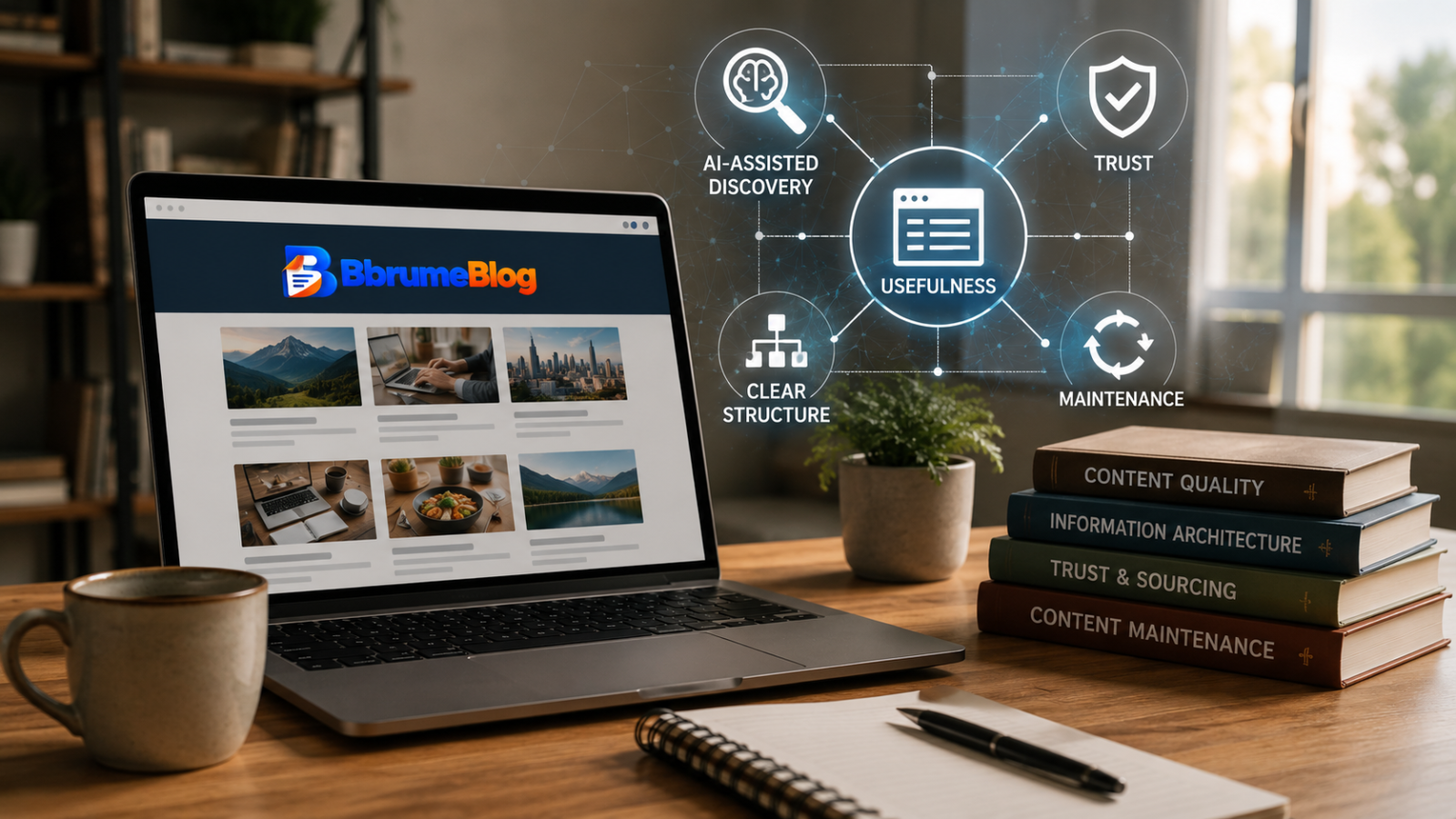
BrumeBlog Com sits within a broader change in online publishing: covering many subjects is no longer enough on its own. As search experiences become more AI-assisted and the web fills with easily replicated information, the value of a blog increasingly depends on whether its pages offer clear purpose, useful context, strong organization, reliable sourcing, and information worth maintaining over time.
For a broad multi-topic publication, the future challenge is not simply adding more subjects. It is making sure each topic area develops enough structure and purpose that readers can understand what each page contributes and why it belongs on the site.
Readers who want additional context can see what the site covers before exploring the broader discussion of online blogging.
Table of Contents
ToggleWhere BrumeBlog Com Fits Into the Future of Online Blogging?
BrumeBlog Com follows a broad publishing model rather than concentrating on one narrow subject. That gives the site room to publish across different areas, but it also creates a long-term editorial challenge: breadth has to remain organized enough that individual topic areas do not become collections of unrelated pages.
Because the site’s broader publishing model offers several potential advantages, readers interested in its strengths can also explore the benefits of a multi-topic publishing model. That additional context helps explain why a broad publication can serve different reader interests while still requiring careful organization.
The future-facing question is more specific: can a broad publication continue to create useful depth while keeping its subject areas coherent as online discovery changes?
There is no basis for claiming that BrumeBlog will definitely follow any particular publishing direction. The factors discussed below are conditions that could influence the future relevance of a broad site like this, not announced plans or guaranteed outcomes.
Blogging Is Moving From Content Volume to Content Usefulness
Publishing more pages does not automatically make a publication more useful.
Google’s current guidance for people-first content asks publishers to consider whether a page contributes original information, provides substantial value, and leaves readers feeling they learned enough to achieve their goal. It also warns against producing large amounts of content mainly to attract search traffic.
That guidance applies specifically to Google Search, but it points to a practical publishing problem as well: a page that exists only because another keyword can be targeted adds little if it does not improve the reader’s understanding.
For BrumeBlog Com, this matters because a broad site already has many possible directions in which it can expand. The stronger future strategy is not simply to add another subject whenever an opportunity appears, but to make each new page strengthen an existing area, answer a distinct question, or provide context that is not already available elsewhere on the site.
Why Generic Content Faces More Pressure
Commodity information is easier to produce and easier to summarize.
A basic page that restates facts widely available across the web has less reason to earn a reader’s attention when search engines and AI systems can surface similar information quickly. Google documents that its AI-powered Search features can generate summaries and connect users with supporting web sources.
Google does not say that every blog must become highly specialized or that conventional articles are becoming obsolete. A reasonable editorial implication, however, is that pages built around widely repeated facts need a clearer reason to be visited.
That reason might be better organization, stronger evidence, useful interpretation, clearer examples, original reporting, or a more precise answer to a difficult question. In other words, future blog content will need to be less interchangeable.
For a broad publication such as BrumeBlog Com, that makes differentiation important at the page level. A site can cover many subjects, but each page still needs to contribute something more useful than another generic summary.
Search and AI Are Changing How Blog Content Gets Discovered
Search discovery is becoming less dependent on a simple list of links.
Google now includes AI-powered experiences within Search and says that content appearing in those experiences remains subject to its normal Search requirements. The company continues to recommend useful, reliable, people-first content rather than special pages created specifically for AI features.
That is the documented part.
The broader publishing implication is that articles increasingly need to work in two ways at once: they should communicate their purpose quickly, while still offering enough substance that visiting the full page is worthwhile.
A vague article that circles around a broad topic may be easy to summarize but hard to justify as a destination. A focused article with clear sourcing, well-defined sections, and useful interpretation gives both readers and search systems a stronger understanding of what the page actually contributes.
What This Means for a Multi-Topic Publication
A broad site cannot rely on one overall theme to explain every article.
Because BrumeBlog Com covers multiple subject areas, its future organizational challenge is likely to become more demanding as the archive grows. Individual pages need clear topical context, and related pages need understandable relationships.
That does not require forcing every subject into one artificial theme. It means making each topic area internally coherent enough that a reader can see where one article fits, what question it answers, and what related material logically comes next.
As broad sites expand, that kind of structure becomes part of the content itself.
Clear Content Organization Will Matter More on Broad Websites
Information architecture becomes more important as subject breadth increases.
Information architecture is the way a website groups, labels, and connects its content so readers can understand where they are and where to go next. On a broad publication, poor organization can make useful pages feel isolated even when the individual articles are strong.
A growing multi-topic site benefits from clear category boundaries, descriptive navigation, sensible internal linking, and distinct page purposes. These elements help prevent multiple articles from drifting toward the same intent or becoming difficult to distinguish.
For BrumeBlog Com, the current-state-to-future connection is straightforward: because the site already publishes across different subject areas, future growth is more likely to create value when new content deepens those areas rather than simply expanding the number of subjects.
The archive should become easier to understand as it grows, not harder.
Trust Signals Are Becoming More Important in Online Publishing
Readers need ways to judge where information comes from and how much weight to give it.
Google’s people-first content guidance recommends clear sourcing, evidence of expertise where relevant, identifiable authorship where appropriate, and freedom from factual errors. Those recommendations are specific to search quality, but they also reflect a practical standard for publishing information people may rely on.
The level of evidence should match the subject.
A casual article may need only accurate facts and clear attribution. A page dealing with medicine, law, finance, technical systems, or another consequential topic may require primary sources, qualified expertise, or explicit limits on what the article can establish.
For BrumeBlog Com, this becomes more important precisely because the site is broad. Different topics carry different evidence requirements. A publishing model that treats every subject with the same level of sourcing can become inconsistent as the archive expands.
Future relevance therefore depends partly on matching the strength of the evidence to the seriousness of the claim.
Updating Existing Content May Matter as Much as Publishing New Articles
A growing publication eventually becomes responsible for an archive, not just a stream of new posts.
Some information remains useful for years. Other material changes because software is updated, regulations are revised, products disappear, prices move, services change, or new evidence emerges.
Google recommends using accurate publication and update dates and warns against changing dates merely to make unchanged content appear fresh. A page should be presented as updated when meaningful revisions have actually occurred.
For a broad site, this creates a maintenance problem that becomes larger over time. The more subjects a publication covers, the more types of information may require periodic review.
That is particularly relevant to BrumeBlog Com’s model. Future expansion would not only increase the number of pages available; it would also increase the number of pages that may need to be checked for continued accuracy.
Publishing decisions therefore have a long-term cost. Every time-sensitive page added today may become a maintenance responsibility later.
Broad Blogs Will Need Stronger Topic-Level Identity
A multi-topic publication can remain broad while still developing recognizable depth inside individual subject areas.
Topic-level identity means that related pages feel intentionally connected. A reader entering one area of the site should be able to understand what kinds of questions that section answers and how one article differs from another.
This is especially important for a publication like BrumeBlog Com because broad coverage can otherwise create semantic overlap. If several pages approach nearly the same question from slightly different wording, the archive grows without becoming more useful.
A stronger topic area develops through distinct roles: one page may explain a concept, another may answer a follow-up question, and another may analyze a related development. Each contributes something different while still belonging to the same subject.
Breadth Without Randomness
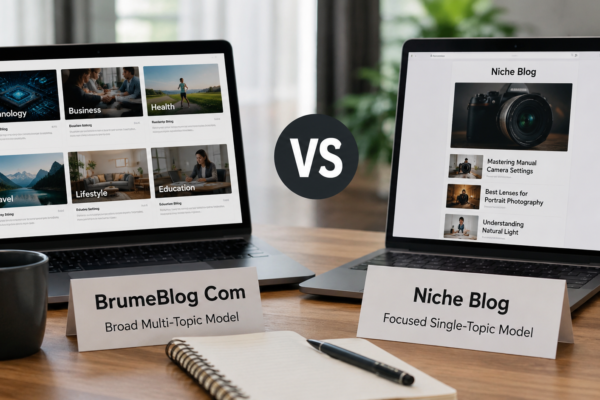
The strongest distinction is intentional breadth versus random breadth. This distinction also becomes clearer when broad publishing is compared with a specialized approach. Readers interested in that difference can explore the comparison between BrumeBlog Com and niche blogs to see how breadth and specialization differ in terms of content focus and editorial flexibility.
Intentional breadth allows a publication to cover many subjects while still building meaningful relationships inside each one. Random breadth produces disconnected pages that happen to live on the same domain.
The difference comes from editorial purpose.
If a new article fills a genuine information gap, extends an existing subject, or answers a useful follow-up question, it strengthens the publication. If it exists only because another searchable phrase is available, it may increase page count without increasing reader value.
Google’s people-first guidance similarly cautions against entering topics mainly because they appear capable of attracting search traffic and recommends having an intended audience and a clear purpose for content.
For BrumeBlog Com, the future value of breadth will depend less on how many subjects are present and more on whether each subject develops with enough coherence to feel deliberate.
Human Judgment Still Matters in an AI-Assisted Publishing Environment
AI can speed up parts of content production, but editorial judgment still determines whether the result is useful.
Google’s guidance does not prohibit AI-assisted content creation. Its concern is whether content is useful, original, accurate, and created primarily for people rather than to manipulate rankings.
AI tools can assist with research organization, drafting, summarization, and editing. They cannot remove the need to decide which source deserves trust, whether two claims conflict, what context is missing, or when a statement is too uncertain to publish.
Those decisions become more important as easily generated content becomes more common.
For a broad publication, human review also helps maintain consistency across very different subjects. A technology article, a finance article, and a lifestyle article may all require different standards of evidence and different levels of caution.
There is no verified basis for saying how BrumeBlog Com currently uses AI, and no such assumption is necessary. The broader point is that AI-assisted publishing increases the value of thoughtful editing because readable text alone is becoming easier to produce.
What Could Keep BrumeBlog Com Relevant as Blogging Evolves?
BrumeBlog Com’s future cannot be predicted from its current format, and none of the directions discussed here should be treated as confirmed plans.
A more useful way to assess its future is to look at the conditions under which a broad publication remains valuable.
Clear page purpose will matter. Each article should answer a distinct question rather than repackage another page with slightly different wording.
Topic areas will need coherence. Because BrumeBlog already spans unrelated subjects, future growth would be stronger if individual areas develop meaningful depth instead of simply adding more categories or isolated posts.
Sourcing will need to match the claim. General information can remain accessible, while consequential subjects require stronger evidence and clearer boundaries.
Maintenance will become increasingly important as the archive expands. Publishing a page is only the beginning when the underlying information can change.
And individual articles will need a reason to be visited in an environment where commodity information can be summarized quickly. Context, evidence, interpretation, structure, and clear editorial judgment can provide that reason.
The future of BrumeBlog Com therefore depends less on whether broad blogging survives and more on whether broad publishing can remain purposeful. Useful depth, coherent organization, appropriate sourcing, ongoing maintenance, and a clear reason for every page to exist are the factors most likely to determine whether that model continues to serve readers well.
The broader discussion around why BrumeBlog Com is gaining attention also provides another perspective on how the publication fits into the changing online publishing environment.
Frequently Asked Questions
Will AI-assisted search make traditional blogs unnecessary?
No. AI-assisted search can summarize information, but Google still uses web pages as supporting sources in AI Overviews and AI Mode and provides links for further exploration. The stronger implication for publishers is that articles need a reason to be visited, such as useful context, evidence, interpretation, or depth that a short summary cannot provide.
Does a multi-topic blog need to focus on only one subject to remain useful?
Not necessarily. Covering multiple subjects is not inherently the problem; the bigger issue is whether the content has a clear purpose and serves its intended audience. Google’s people-first guidance emphasizes useful content and warns against entering unrelated topics primarily to capture search traffic.
What does “non-commodity content” mean for a broad publication?
Non-commodity content gives readers something beyond facts that can be easily repeated or summarized elsewhere. That might include stronger evidence, clearer organization, original analysis, useful context, or a particularly helpful explanation. Google specifically highlighted valuable, unique, non-commodity content in its 2026 guidance for generative AI features in Search.
Does BrumeBlog Com need special content or markup for AI search?
There is no special Google requirement for appearing in AI Overviews or AI Mode. Google says publishers do not need special AI files, dedicated AI markup, or unique schema for these features; normal Search requirements and useful, people-first content remain the foundation. This describes Google’s Search systems, not other AI platforms.
Can AI-generated content still be useful for an online publication?
Yes, AI-assisted or AI-generated content is not automatically against Google’s guidelines. Google focuses on the purpose and quality of the result, including accuracy, relevance, originality, and whether automation is being used mainly to manipulate Search rankings. Human review remains important when facts, sources, uncertainty, or specialist knowledge need careful judgment.
Does every older blog post need to be updated regularly?
No. Updates are useful when the underlying information has materially changed, not simply because a page is old. Evergreen explanations may remain accurate for long periods, while articles involving changing products, rules, software, or other time-sensitive information may need more attention. Google also advises against changing dates merely to make unchanged content appear fresh.
Tagged: Blogging BrumeBlog Com Future of Online Blogging Online Content