
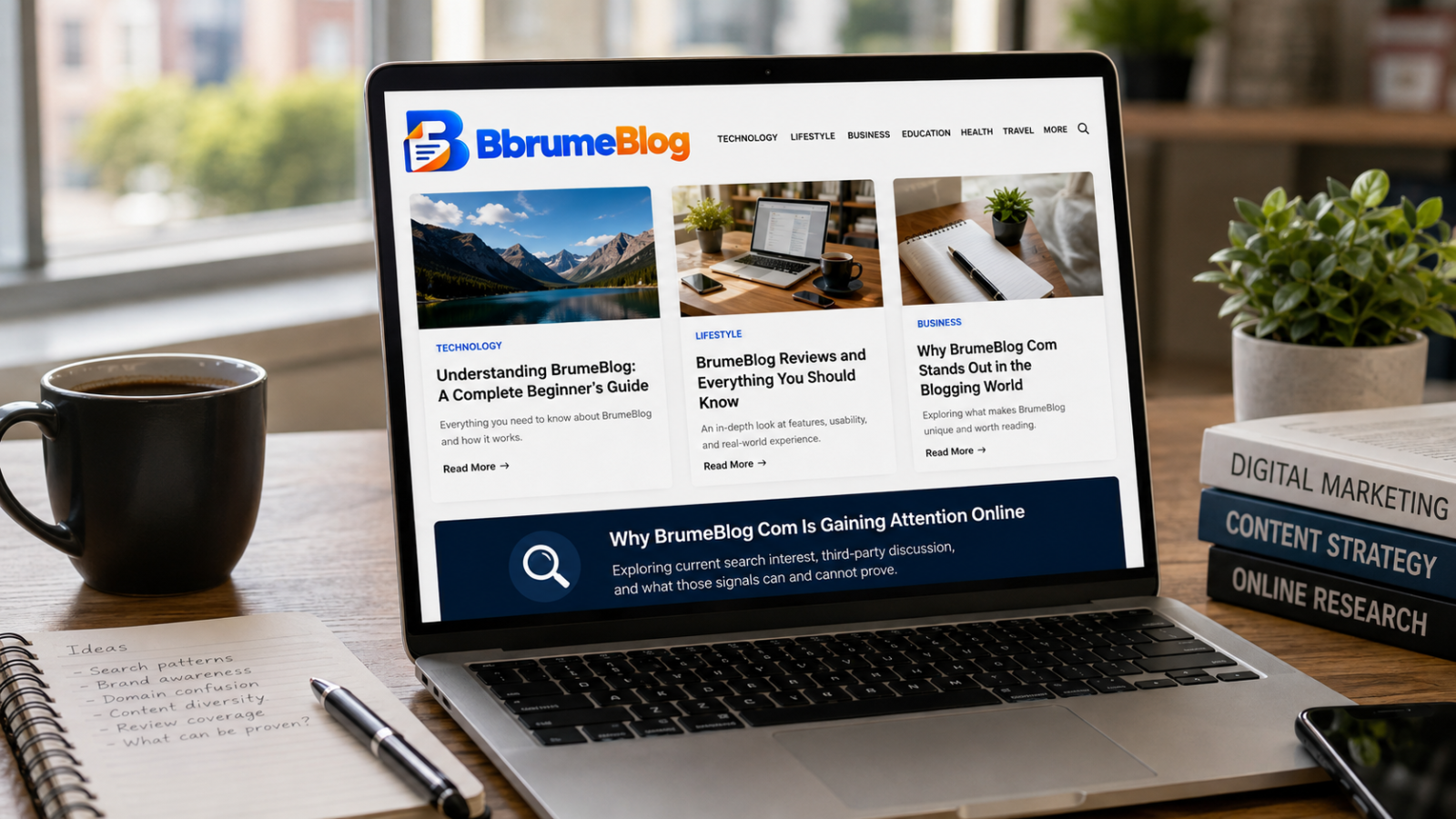
BrumeBlog Com currently has a visible search and discussion presence because the name appears across recent reviews, guides, explainers, and credibility-focused pages. Current Google results show that multiple publishers are treating BrumeBlog-related terms as something readers may want explained or evaluated.
This article looks at those current search-result patterns. It does not have access to BrumeBlog Com’s private traffic data, branded-search analytics, subscriber numbers, or other internal measurements. That means the evidence can explain why the name is attracting online interest, but it cannot prove that traffic, readership, or popularity is growing.
Table of Contents
ToggleWhy BrumeBlog Com Is Gaining Attention Online: The Short Answer
The clearest explanation is a combination of visible third-party coverage, search results that frame BrumeBlog Com as something worth identifying, similarly named domains that can create confusion, and a broad publishing structure that creates multiple possible contexts in which the name may be encountered.
Recent results include review-style and guide-style pages specifically centered on BrumeBlog-related searches. For example, Technected published a multi-niche review, The Media Magazine published a “right for you?” review, and Baddiehu published a broader guide covering content, credibility, and user experience.
These results show that the name has a current online discussion footprint. They do not establish a historical increase in searches, traffic, or audience size.
To learn more about its broader publishing approach, explore BbrumeBlog.
Multiple Third-Party Pages Are Discussing the BrumeBlog Name
Current search results contain several independent pages built around the BrumeBlog name.
Their formats vary. Some are reviews, some are beginner-style guides, and others focus on credibility, features, or user experience. That matters because BrumeBlog Com is not appearing only as a passing reference inside unrelated articles. In many cases, it is the main subject of the page.
For a reader searching the brand name, this creates a search environment in which multiple publishers are trying to explain or assess what BrumeBlog Com represents.
The useful signal here is the existence of that current coverage, not the accuracy of every claim inside those third-party articles.
Coverage Shows Interest, Not Audience Size
Third-party coverage should not be treated as a substitute for analytics.
A collection of BrumeBlog-focused pages can demonstrate that publishers are writing about the term. It cannot tell us how many people searched for it, how many readers visited the publication, or whether those numbers changed over time.
Some third-party pages use language suggesting that BrumeBlog Com is “gaining” attention or developing momentum. Those statements may describe an editorial impression, but without supporting measurements they should not be treated as proof of audience growth.
The evidence supports a simpler conclusion: BrumeBlog Com is currently the subject of visible third-party search coverage.
Search Results Are Creating a “What Is This Site?” Curiosity Loop
The structure of the current search results can itself encourage people to investigate the name further.
Several pages are framed around questions such as what BrumeBlog Com is, whether it is worth reading, what it offers, or how credible it may be. One current guide, for example, leads directly with “What is brumeblog com?” while another presents itself as a complete review.
This creates a reasonable “What is this site?” interpretation of the search environment.
Someone who encounters the BrumeBlog name may search for it and then see several results that frame the brand as something requiring explanation. Those results can make the branded term itself feel more prominent within search.
That should not be confused with verified user behavior. There is no basis here for claiming that most readers discover BrumeBlog Com through this exact sequence.
Similar BrumeBlog Names Make Identification More Important
BrumeBlog-related searches also surface multiple similarly named websites.
For example, current results include domains such as RealBrumeBlog.com and Brume-Blog.com alongside third-party pages using “BrumeBlog com” in their titles.
That naming overlap can make entity identification harder.
A similar domain name does not prove that two websites have the same owner, editorial team, company, publishing operation, or business relationship. It also does not establish that one site is an official mirror of another.
Readers should therefore avoid transferring claims from one BrumeBlog-style domain to another without verification.
Why the Exact Domain Matters
The safest approach is simple: check the exact web address before applying information about one website to another.
This is especially important when reading third-party reviews. A review may discuss a similarly named domain, describe a different publication, or make assumptions about an entity that are not clearly supported.
Readers who want the broader site overview rather than an explanation of the current search interest can refer to the main BrumeBlog Com guide.
Broad Content Exposure Creates More Possible Entry Points
A broad publishing structure also creates more possible topical contexts in which a publication’s name could be encountered.
A site that publishes across multiple subject areas can potentially have pages appearing around different kinds of informational searches. This broader publishing model can also give readers more opportunities to discover useful subjects across different areas, as discussed in the BrumeBlog Com benefits guide.
In structural terms, that creates more possible entry points than a publication whose entire content library stays within one narrow subject. That does not mean broad publishing automatically produces higher traffic or stronger rankings.
The point is narrower: a multi-topic publication can be encountered in more than one topical context, which gives its brand name more possible places to appear across the web and in search results.
This is a structural possibility, not evidence of measured growth.
Review-Style Search Results Are Reinforcing Brand Curiosity
Another notable feature of the current results is how often BrumeBlog-related pages are framed as evaluations.
Titles and descriptions use formats such as reviews, complete guides, credibility checks, feature breakdowns, and user-experience assessments. The Media Magazine and The Geek Insights are representative examples of that pattern.
That framing can make the brand look like something people are trying to understand rather than simply a publication appearing in ordinary topical search results.
In practical terms, the search page is not only showing content from or about a website. It is also showing pages asking readers to evaluate the website itself.
That can reinforce branded interest without proving anything about the size of the audience behind it.
Online Attention Should Not Be Confused With Proven Popularity
The most important limit on the evidence is that search-result presence is not the same as popularity. The difference between broad publishing and specialized sites is explored further in this comparison of BrumeBlog Com and niche blogs.
Current third-party coverage does not establish:
- rising traffic;
- increasing branded-search volume;
- audience growth;
- subscriber growth;
- social-media growth;
- viral reach;
- or increasing popularity.
Those claims would require reliable before-and-after data from appropriate analytics or measurement sources. For example, Google Trends can be used to examine how search interest for a term changes over time, although it should not be treated as a direct measure of website traffic.
For readers, the practical takeaway is that current online discussion can be observed, while the scale or growth of BrumeBlog Com’s audience cannot be established from search results alone.
What the Current Attention Around BrumeBlog Com Actually Tells Us
The strongest evidence-based conclusion is that BrumeBlog Com currently has a visible branded search presence supported by multiple third-party reviews, guides, and evaluation-style pages.
Several factors can reasonably help explain that interest: the brand is being discussed directly by outside publishers, current search results frequently frame it as something to identify or assess, similarly named domains can create entity confusion, and a broad publishing structure gives the name multiple possible topical contexts in which to appear.
What those signals do not prove is equally important. They do not establish that BrumeBlog Com’s traffic, search volume, readership, or popularity is increasing.
The most accurate interpretation is therefore a current-state one: BrumeBlog Com has a visible online discussion and search footprint, and the surrounding search environment helps explain why people may be investigating the name.
Frequently Asked Questions
Why are people searching for BrumeBlog Com?
People may search for BrumeBlog Com after encountering the name in search results, articles, or third-party reviews and wanting to understand what it refers to. Current Google results include several guides and evaluation-style pages centered on BrumeBlog-related terms, which shows that the name has become a subject of online investigation.
Does the current search presence mean BrumeBlog Com is becoming more popular?
No. A visible search presence does not prove that BrumeBlog Com’s popularity, traffic, or audience is increasing. Search results show that multiple publishers are currently discussing the name, but reliable before-and-after analytics would be needed to establish actual growth.
Why do so many BrumeBlog Com review pages appear in search results?
Review and guide pages often appear because publishers are addressing branded questions such as what a site is, what it offers, and whether readers should investigate it further. Current results include beginner guides, reviews, and broader explainers focused specifically on BrumeBlog-related searches.
Are all websites using the BrumeBlog name connected?
No. Similar names or domains do not prove common ownership, shared editorial operations, or any official relationship. Search results currently surface several BrumeBlog-style domains, so readers should check the exact web address before applying information about one site to another.
How can I tell which BrumeBlog website a review is discussing?
Check the exact domain named or linked in the review and compare it with the website you intended to research. Do not rely only on similar branding or spelling. If the review does not clearly identify the domain, its claims should not automatically be treated as facts about another BrumeBlog-style website.
Can BrumeBlog Com’s broad range of content contribute to online interest?
It can create more possible contexts in which readers might encounter the publication’s name. A multi-topic publishing structure can place a brand alongside different informational subjects, but that is only a structural possibility. It does not prove that broad coverage has produced higher traffic, stronger rankings, or measurable audience growth.
What is the best way to evaluate claims about BrumeBlog Com’s growth?
Look for evidence that directly measures the claim being made. Statements about rising traffic, search demand, readership, or popularity require reliable analytics or comparable before-and-after data. Third-party reviews and search-result presence can show current discussion, but they cannot establish growth on their own.
Tagged: Blogging BrumeBlog Com Gaining Attention Online Online Content