
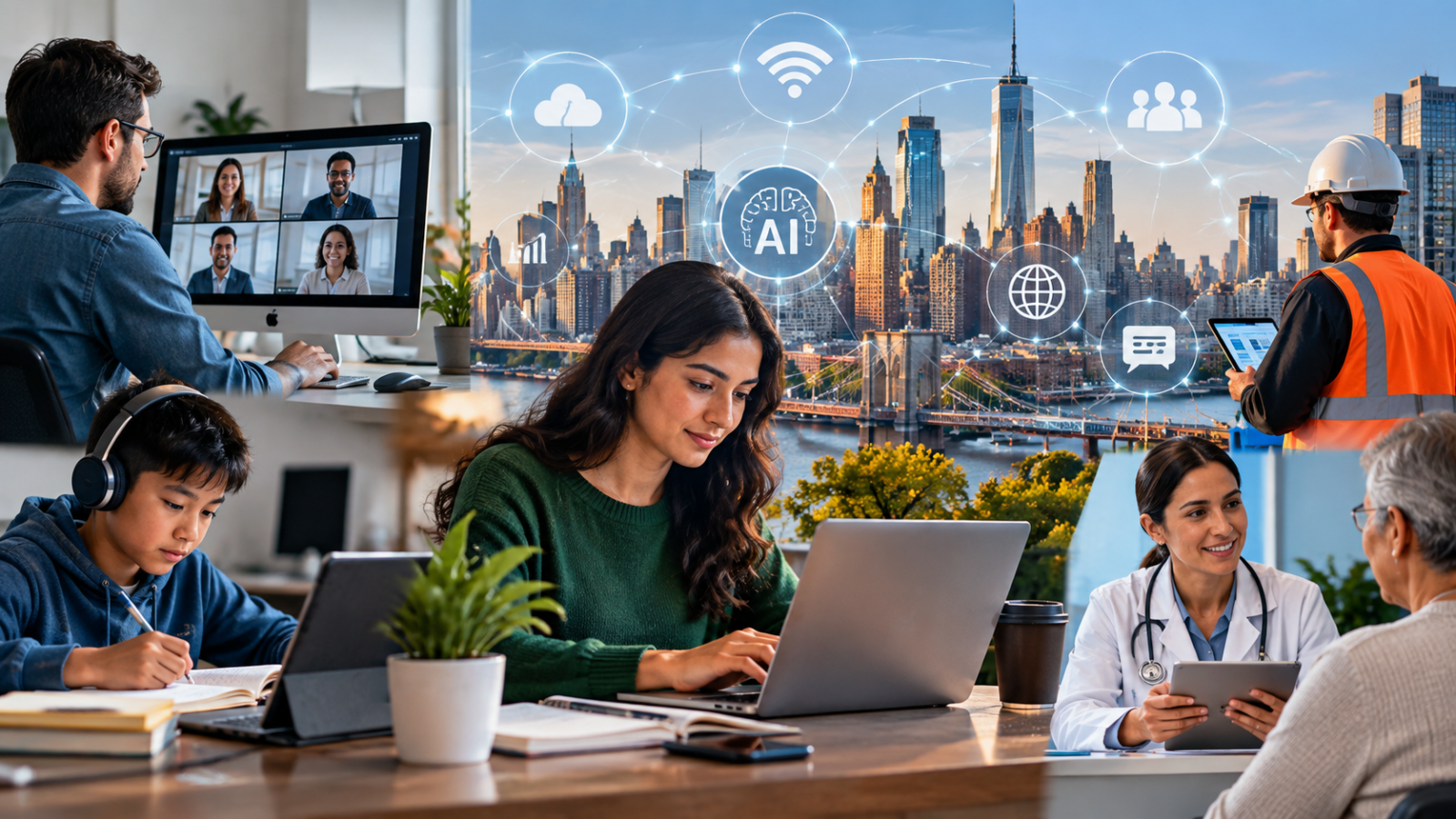
Technology has changed society by making communication faster, information easier to access, many tasks more efficient, and services available from almost anywhere. It has also reshaped how Americans work, learn, shop, manage money, receive health care, build relationships, and participate in communities.
The effects are not entirely positive or negative. Digital tools can create convenience and opportunity while also introducing concerns about privacy, cybersecurity, misinformation, unequal access, workplace disruption, and dependence on digital systems. Understanding how technology has impacted society therefore requires looking at both what technology enables and what changes follow once people and institutions begin organizing their lives around those capabilities.
Table of Contents
ToggleHow Has Technology Impacted Society?
Technology has made society more connected, information-driven, and dependent on digital systems. Activities that once required travel, paperwork, physical media, or face-to-face interaction can increasingly be handled through a phone or computer.
The wider social impact usually develops in stages. A new technology first creates a capability—such as communicating instantly across distance. People then change their behavior because that capability is available. As those behaviors become common, expectations and incentives change. Employers, schools, businesses, health systems, and government agencies adapt to those expectations, and their adaptations can produce broader changes in how society operates.
Video conferencing offers a simple example. An office worker may use it to work from home and avoid a commute. A patient may use the same basic technology to speak with a health professional without traveling to a clinic, while a student may attend a remote class. A restaurant employee, construction worker, nurse, or delivery driver may receive far less direct benefit from remote-work technology because the job requires physical presence. The effect of a technology therefore depends on a person’s work, access, circumstances, and how the technology is used.
Artificial intelligence is becoming part of this broader shift. In a Pew Research Center survey conducted February 17–23, 2026, 49% of U.S. adults reported using AI chatbots. The survey also found that 42% of U.S. adults used them to search for information and 38% of employed adults used them for work tasks. These figures describe AI use in 2026 and should be treated as a current snapshot rather than a permanent measure of adoption.
The larger change is not simply that society has more devices. Technology increasingly influences what people expect from employers, schools, businesses, health systems, public agencies, and one another.
How Technology Has Changed Everyday Life
Digital tools have made many routine activities faster and less dependent on a particular location or schedule.
A smartphone can function as a camera, map, calendar, payment tool, communication device, entertainment center, shopping portal, and information source. Online banking lets customers check balances or transfer money without visiting a branch. Navigation apps update routes in real time. Streaming services provide entertainment on demand, while online stores allow customers to compare products and arrange delivery or pickup from home.
These conveniences also create new dependencies. Losing access to a phone, internet connection, password, payment account, or online service can interrupt several parts of daily life at once. A software outage that might once have affected only an office computer can now interfere with transportation, payments, communication, appointments, or access to records.
That illustrates an important feature of digital society: as one device or service takes on more functions, convenience increases, but so does the consequence when access fails.
Communication and Access to Information
One of technology’s clearest social effects is the speed at which people can communicate and obtain information.
Email, messaging apps, video calls, group chats, and social platforms allow people to maintain contact across cities, states, and countries. Work teams can collaborate without occupying the same building, while families and friends can share conversations, photos, and events almost instantly.
Search engines, online databases, digital libraries, educational platforms, news sites, and AI tools have also reduced the effort required to locate information. Pew’s February 2026 survey found that 42% of U.S. adults reported using AI chatbots to search for information.
Faster access, however, does not guarantee better information. A search result or AI-generated answer can be outdated, incomplete, misleading, or simply wrong. That makes source evaluation an increasingly important digital skill.
For consequential information, readers should check who published it, when it was updated, whether evidence is provided, and whether the claim can be confirmed through an original or authoritative source. The easier information becomes to produce and distribute, the more important verification becomes.
How Technology Has Changed Work and the Workplace
Digital technology has changed where people work, how teams coordinate, what tasks can be automated, and which skills employers value.
Cloud services allow employees to access shared files and business systems from different locations. Video meetings connect teams across states and time zones. Project-management platforms, messaging tools, and shared documents allow work to continue without everyone being in the same office.
Remote work remains a substantial part of the U.S. labor market, although its availability differs sharply by occupation. According to U.S. Bureau of Labor Statistics 2025 annual averages, 22.4% of people at work teleworked or worked from home for pay for at least some of their working hours. Among people in management, professional, and related occupations, the figure was 37.2%.
Those figures should be read as 2025 estimates rather than as evidence of a particular year-over-year trend. The BLS notes that its 2025 annual telework estimate covers 11 months because October data are excluded, so it is not strictly comparable with annual averages for other years.
Digital work can also increase expectations about availability. When email, messaging, and cloud systems are accessible almost everywhere, the boundary between working time and personal time can become less clear. Whether that improves flexibility or creates additional pressure depends partly on workplace policies and how organizations use those tools.
Automation, AI and Changing Skills
Automation and artificial intelligence are changing specific work tasks, but their effects should not be reduced to the claim that technology either “destroys jobs” or “creates jobs.”
A single occupation contains many different tasks. Software may automate repetitive calculations, scheduling, sorting, transcription, initial drafting, or data processing while leaving other parts of the same job dependent on judgment, accountability, physical presence, interpersonal communication, creativity, or specialized expertise.
That distinction between jobs and tasks matters. Automating one part of a job does not necessarily eliminate the occupation, just as introducing a new digital tool does not automatically increase employment.
Generative AI has expanded automation into activities involving text, images, code, research assistance, and customer support. Pew’s February 2026 data show that 38% of employed U.S. adults reported using AI chatbots for work tasks.
As these tools spread, workers may need both technical skills and the ability to evaluate technology critically. An AI system may produce a useful draft while still making factual, logical, or contextual errors. In work where accuracy carries consequences, human review remains important.
How Technology Has Changed Communities and Relationships
Digital communication has made it easier to maintain relationships across distance and form communities around shared interests, experiences, or goals.
Families can stay in frequent contact across states or countries. Neighborhood groups can share local information. Professional communities can connect workers who would rarely meet in person. People with uncommon hobbies, health experiences, or specialized interests can find others with similar experiences.
These benefits do not mean digital interaction automatically strengthens relationships. Nor does online communication necessarily damage them. The effect depends on what the technology is replacing, supplementing, or enabling.
A video call may help maintain a long-distance relationship that otherwise would involve little contact. Constant phone notifications during an in-person conversation may have the opposite effect. Social platforms may help people find community while also exposing them to conflict, harassment, misinformation, or unwanted comparison.
The useful question is therefore not whether digital communication is inherently better or worse than face-to-face interaction. It is how a particular form of technology affects the quality, frequency, and purpose of interaction in a given situation.
From Local Communities to Online Communities
Technology has expanded the idea of community beyond geographic location.
People now form groups around professions, education, parenting, gaming, hobbies, health experiences, creative interests, and many other shared concerns. Someone living far from a major city can participate in a specialized community whose members are spread across the country or around the world.
Online groups can provide information, discussion, and a sense of connection, especially when similar people or resources are difficult to find locally. Physical communities offer different advantages, including proximity and the ability to provide direct, place-based support.
Rather than assuming one form is superior, it is more accurate to treat online and local communities as different forms of social connection whose usefulness depends on the person’s needs and circumstances.
How Technology Has Changed Education and Learning
Technology has expanded where, when, and how people can learn.
Students can use digital textbooks, research databases, recorded lectures, educational videos, interactive exercises, and online courses. Adults can develop professional skills without enrolling in a traditional full-time program, while employers can provide training to workers across multiple locations.
Digital learning can reduce barriers created by geography and scheduling, but access to online material does not guarantee effective learning. Students still need reliable connectivity, suitable devices, accessible software, appropriate instruction, and the ability to evaluate sources.
AI tools add another layer. They can explain concepts in different ways, generate practice questions, help organize ideas, or provide feedback on drafts. They can also generate incorrect information or allow a student to produce work without developing the skill that the assignment is intended to teach.
The useful distinction is between using technology to support learning and using technology to bypass learning. A tool provides greater educational value when it helps a learner understand, practice, investigate, or create rather than simply replacing the thinking the learner needs to develop.
How Technology Has Improved Access to Services and Opportunities
Digital systems can improve access by reducing barriers created by distance, opening hours, transportation, and location.
Telehealth can allow some patients to speak with health professionals without traveling to a clinic. Online banking gives customers access to many routine financial services outside branch hours. Job seekers can search openings beyond their immediate area. Small businesses can reach customers without relying solely on a physical storefront.
Public agencies also provide many forms, records, information, applications, and account services online.
But moving a service online does not automatically make it equally accessible. A website may technically be available nationwide while remaining difficult to use for someone with unreliable internet, an unsuitable device, limited digital skills, or accessibility needs.
That distinction becomes important as more essential services assume that users can participate digitally.
What Are the Positive Effects of Technology on Society?
The main benefits of technology come from reducing barriers involving distance, time, information, and coordination.
Among the most important effects are:
- Faster communication across long distances
- Easier access to information and educational resources
- Greater flexibility for some types of work
- More efficient handling of repetitive or information-heavy tasks
- Remote access to banking, shopping, health services, and public information
- New ways for individuals and businesses to reach customers or audiences
- More opportunities to maintain relationships and communities across distance
These advantages often reinforce one another. Better connectivity can simultaneously affect a person’s work, education, access to services, and relationships.
The size of the benefit, however, depends on whether the person can actually use the technology effectively. That is why access and digital inequality are central to understanding technology’s social impact rather than separate issues.
What Are the Negative Effects of Technology on Society?
The main disadvantages arise when digital systems create new risks or when people become dependent on systems they cannot use equally or safely.
Key concerns include privacy loss, cybercrime, misinformation, online harassment, unhealthy patterns of technology use, disruption of some workplace tasks, unequal digital access, and dependence on platforms or networks that can fail.
Some effects require careful interpretation. An OECD analysis published in 2025 found that more than two hours per day of personal screen use was associated with a greater likelihood of poorer subjective well-being across the countries studied, including the United States. It did not establish that screen time caused poorer well-being. Sleep deprivation, low physical activity, and financial hardship were stronger predictors in the analysis.
The broader lesson is that technology’s effects often depend on context. The same amount or type of use may not have the same meaning for a student studying online, an employee working remotely, and someone spending hours scrolling social media.
Privacy, Security and Misinformation
Digital services often depend on collecting and processing data. Depending on the service, that information can include account details, purchases, preferences, activity, location, or browsing behavior.
This creates practical privacy questions: What information is being collected? Why is it necessary? How long will it be retained? Who can access it?
Security is a related problem. Phishing, fake websites, stolen credentials, malicious software, account takeovers, and impersonation schemes can exploit the same connectivity that makes online services convenient.
Basic precautions remain useful:
- Use different passwords for important accounts.
- Enable multifactor authentication when available.
- Keep devices and software updated.
- Treat unexpected requests for passwords, money, or verification codes with caution.
- Verify important requests through an organization’s official website or contact information.
Misinformation presents a separate challenge. False material can move through the same channels as reliable information, often with similar speed and presentation.
AI-generated content makes verification even more important because a fluent answer is not necessarily an accurate one. For health, financial, legal, safety, or other high-stakes decisions, readers should verify important claims with appropriate authoritative sources rather than treating an AI response as final evidence.
The Digital Divide and Unequal Access
The digital divide is not simply a question of whether a household can connect to the internet.
The U.S. Census Bureau’s 2024 American Community Survey 1-Year Estimates counted 132,737,146 U.S. households. Of those, 123,873,624 had an internet subscription, while 6,026,410 were reported as having no internet access.
Those figures show that basic connectivity is widespread, but nominal internet access is not the same as meaningful digital participation.
Several separate conditions determine whether someone can actually benefit from online systems:
- Connection: Is internet service available at all?
- Reliability: Is the connection stable and fast enough for tasks such as video calls, online classes, telehealth, or large downloads?
- Affordability: Can the household consistently pay for service without sacrificing other necessities?
- Appropriate devices: Does the person have a suitable laptop, tablet, or smartphone for the task rather than merely some form of internet-connected device?
- Digital skills: Can the person create accounts, complete forms, evaluate information, protect credentials, and troubleshoot basic problems?
- Accessibility: Can people with disabilities use the website, application, device, or digital service effectively?
A household may therefore appear “connected” in a statistical measure while still facing serious barriers to online education, remote work, telehealth, job applications, or public services.
As institutions move more activities online, the quality and usability of access matter alongside whether a connection technically exists.
Has Technology Made Society Better or Worse?
Technology has improved many aspects of life, but its overall social impact cannot be accurately reduced to a simple positive or negative verdict.
The same technology can create a benefit in one situation and a disadvantage in another.
Remote work can remove a commute and increase flexibility for an office employee, yet offer little benefit to someone whose occupation must be performed on site. Social media can help someone maintain distant relationships while also exposing users to harassment or misinformation. AI can speed up certain tasks while creating new questions about accuracy, privacy, accountability, and changing job requirements. Online services can improve convenience while creating barriers for people who cannot access or use them effectively.
A more useful way to evaluate technology is to ask:
- What new capability does it provide?
- How does that capability change people’s behavior?
- Who benefits, and who may be excluded or disadvantaged?
- What risks or dependencies does the technology create?
- How do institutions respond once the technology becomes widely used?
This approach explains why technology can produce several effects at once. The central issue is not simply whether society should use technology, but how particular technologies are designed, adopted, governed, and integrated into daily life.
Frequently Asked Questions About Technology and Society
What is the biggest impact of technology on society?
One of the broadest impacts is the combination of faster communication and easier access to information.
Those capabilities affect many other parts of society. They enable remote work, online education, digital commerce, telehealth, rapid coordination, long-distance relationships, and access to knowledge from almost anywhere with a suitable connection.
AI-assisted information search is a newer extension of that pattern. In Pew’s February 2026 survey, 42% of U.S. adults reported using AI chatbots to search for information.
How has technology affected human relationships?
Technology has made long-distance communication easier and allowed people to find communities based on shared interests or experiences.
Its effect on individual relationships varies. Digital communication may strengthen contact when distance would otherwise limit interaction, while excessive distraction or poorly handled online communication can interfere with face-to-face relationships.
It is therefore more useful to examine how technology is being used within a relationship than to assume that digital communication is inherently beneficial or harmful.
How does technology affect society economically?
Technology affects the economy by changing productivity, business models, consumer behavior, job tasks, and access to markets.
Companies can automate some processes, analyze information faster, sell products online, and coordinate employees across locations. Workers may gain access to new tools or flexible working arrangements while also facing changes in the tasks employers expect them to perform.
This is why the economic effect of technology cannot be summarized simply as “creating” or “eliminating” jobs. It can automate some tasks, increase demand for others, change existing occupations, and alter the skills workers need at the same time.
Why is the digital divide important?
The digital divide matters because digital participation increasingly affects access to ordinary opportunities and services.
Someone may need reliable internet and an appropriate device to apply for jobs, complete schoolwork, attend a remote appointment, manage financial accounts, obtain government information, or communicate with institutions.
For that reason, meaningful digital access includes more than having an internet connection. Affordability, reliability, devices, skills, and accessibility all influence whether a person can actually participate.
Technology has made American society more connected and capable, but it has also increased the importance of digital access, critical judgment, privacy, security, and responsible use. Its impact is best understood not as a simple list of advantages and disadvantages, but as a chain of changes: new capabilities alter behavior, changing behavior reshapes expectations, institutions respond, and those responses can eventually change how society itself functions.
Readers interested in related developments can explore more technology and artificial intelligence topics across BrumeBlog.
Tagged: artificial intelligence digital transformation future of work impact of technology technology and society